What if a tram could already know, before reaching an intersection, whether pedestrians are present and what state the traffic lights are in? In Tampere, the SmartRail#3 pilot is building exactly this kind of situational awareness. At the same time, it addresses a broader question: how can traffic infrastructure from different suppliers be made to communicate seamlessly?
What is SmartRail#3?
SmartRail#3 is a research project funded by Business Finland and coordinated by VTT. It focuses on developing data-driven solutions for urban mobility in collaboration with multiple stakeholders. The pilot implemented by Nodeon and Aventi aims to provide the tram with a real-time situational awareness of the intersection environment.
One of the most interesting aspects of the pilot is that the intersections are equipped with traffic signal controllers from two different suppliers: Aventi on Rongankatu and Swarco on Sammonkatu. This enables testing in a genuine multi-vendor environment, which in cities is the rule rather than the exception. The pilot also follows the principles of the European C-ITS reference architecture, which defines how vehicles and traffic infrastructure exchange data in a standardized way.
— Urban infrastructure is a combination of systems from multiple suppliers. If we want to build intelligent traffic services on a scale, data from different systems must be integrated into a single, reliable situational view. That is exactly what we aim to demonstrate in this pilot, says Jarno Kallio, head of Research and Development at Nodeon.
How is real-time situational awareness created?
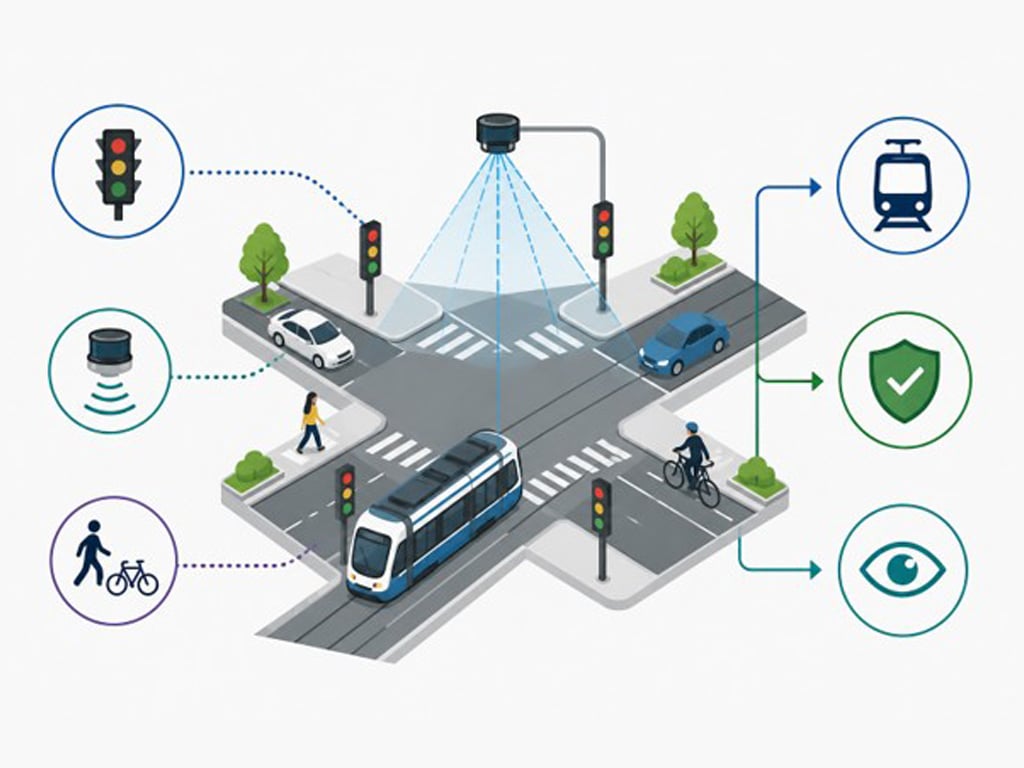
The idea is simple: combine traffic signal state data with sensor observations from the intersection into a unified real-time situational view that can be utilized by a tram or any other application.
Traffic signal systems provide information on their current state and upcoming phase changes. LiDAR sensors, in turn, detect pedestrians, cyclists, and other road users within the intersection. When these two data sources are combined and formatted according to C-ITS standards, they create a situational awareness that enables prediction and supports smoother and safer mobility.
— Existing infrastructure can be made to “speak the same language” when data is converted into a standardized format. The same data can be utilized not only by trams but also by other stakeholders and applications, explains Laura Riihentupa, Product Manager at Aventi.
Asgard – The Digital Core of the Intersection
Nodeon’s Asgard platform serves as the central hub of the solution. It collects data from multiple sources, harmonizes it, and generates a single, reliable situational view for applications to utilize. In the pilot, Asgard receives data from both intersections, integrating inputs from Aventi and Swarco traffic signal systems.
Beyond simple data transmission, Asgard refines the data into actionable insight: it calculates delays and queue lengths and analyzes the impact of signal control on traffic flow. In this way, the platform provides a foundation for dynamic traffic management in urban environments. In the pilot, the situational view is delivered to a web-based tram driver interface with a latency of less than 300 milliseconds.
Although the pilot approaches the solution from the tram’s point of view, the same data can serve buses, emergency vehicles, and other modes of transport. The insights generated by Asgard can also support traffic planning processes and serve as a data source for digital twins and other intelligent systems. In other words, a single solution delivers value to multiple users of situational awareness.
— The idea behind Asgard is to unify fragmented data sources into one reliable situational view on which future intelligent traffic systems can be built. When analytics are centralized, it also becomes possible to develop tools for smarter traffic control, Kallio says.
Collaboration Brings Together Expertise
The pilot is based on a clear division of roles, where each partner’s strengths complement one another. Nodeon is responsible for the Asgard platform, the Sammonkatu intersection including the Swarco traffic signal controller and Nodeon’s own LiDAR system, intersection analytics, and the tram application. Aventi is responsible for the Rongankatu intersection, including traffic signal data, LiDAR-based observations, and technology for identifying special user groups.
— Aventi has a long track record in traffic infrastructure sensing and data processing. This pilot allows us to bring that expertise into a real-world environment and see what it can deliver, says Riihentupa.
Why does this matter?
Urban mobility is becoming increasingly complex: trams, pedestrians, cyclists, and cars all share the same space. Intersections act as critical nodes where safety risks, delays, and unnecessary idling occur – contributing to increased CO₂ emissions.
The experience from the SmartRail#3 pilot so far highlights two key insights. First, existing infrastructure can be leveraged to build intelligent traffic services without heavy new investments. Second, a multi-vendor environment is not a barrier but a natural starting point for this kind of development. Tampere provides a concrete example of an approach that can be applied when developing similar solutions in other cities across Finland and Europe.
The pilot is part of the Business Finland – funded SmartRail#3 research project. Follow the progress – more insights will be shared as the project advances.
More info